
| KEY INSIGHTS |
| 1. Exercise triggers a biphasic pH shift — skin becomes dangerously alkaline at peak sweat, creating a bacterial feeding ground for C. acnes and S. aureus. |
| 2. Physical exercise increases percutaneous absorption of topical actives by over 300% — applying AHAs or retinoids pre-workout is a pharmacokinetic hazard. |
| 3. Wearing cosmetic foundation during training traps sebum inside follicles, increasing intrafollicular sebum by 75% (from 2.4 to 4.2 AU) — the textbook mechanism for acne mechanica. |
| 4. Post-workout TEWL spikes dramatically — the stratum corneum is in a state of crisis for at least one hour after training ends. |
| 5. The Projekt Clarity system is designed around this exact physiology: the Pre-Workout Defence Spray (pH 4.5) stabilises the acid mantle before training; the Syndet Recovery Wash (pH 5.5) resets it after. |
The Problem No One in Indian Skincare Is Talking About
You track your macros, you log your PRs, you dial in your sleep. But your skincare routine? It’s a product you slap on after a shower and hope for the best. The truth is, when and how you apply skincare around your training session determines its effect on your skin far more than the formulation in the bottle.
This is not a beauty editorial. This is a physiological briefing. What happens to your skin during a workout is extreme, time-dependent, and directly relevant to whether your post-workout wash helps or harms you.
Phase 1: What Exercise Does to Your Skin — The Biphasic pH Crisis
The skin’s acid mantle sits between pH 4.5 and 5.5. This slightly acidic film is not cosmetic — it is functional. It controls bacterial colonisation, activates lipid-synthesising enzymes, and keeps the stratum corneum structurally intact. When this pH is disrupted, the barrier fails.
A clinical study tracking 102 subjects across five age groups used a Derma Unit SSC3 to measure facial skin at four stages: resting, beginning of sweat, excessive sweat, and one hour after cessation. The findings matter every time you step into a gym.
Figure 1: The Biphasic pH Shift During Exercise
| Exercise Phase | pH Direction | Clinical Impact | Risk Level |
| Resting State | pH 4.5–5.5 (Stable) | Acid mantle intact, commensal flora protected | Low |
| Start of Sweat | Drops (More Acidic) | Lactic acid excreted; transient protection | Moderate |
| Peak Sweat Phase | Alkaline Shift ↑ | C. acnes & S. aureus proliferate; serine proteases overactivated; barrier tears | HIGH |
| 1 Hour Post-Workout | Recovering ↓ | TEWL spike; lipid deficit; critical intervention window | Moderate |
Source: Effect of Exercise-induced Sweating on facial sebum, stratum corneum hydration, and skin surface pH (PubMed, 2022)
At the start of sweating, pH drops — lactic acid, urocanic acid, and free amino acids in early eccrine sweat make the environment temporarily more acidic. But as sweat volume increases, this buffering capacity is completely overwhelmed. The pH spikes into alkaline territory, particularly at the forehead.
This alkaline shift activates serine proteases — specifically kallikrein-related peptidases (KLK5 and KLK7) — which break down the protein structures binding skin cells together. The result is micro-tearing, abnormal desquamation, and a surface that pathogenic bacteria like Cutibacterium acnes and Staphylococcus aureus actively prefer. Your skin, during peak training, is biologically set up for a breakout.
Phase 2: The Post-Workout TEWL Spike — Your Skin Is Losing Water Fast
Transepidermal Water Loss (TEWL) is the passive evaporation of water through the stratum corneum. Low TEWL means an intact barrier. Elevated TEWL means the barrier has failed and moisture is haemorrhaging outward.
A 2021 non-randomised controlled trial on 58 elite young athletes — comparing swimmers and outdoor football players — measured TEWL before, immediately after, and 30 minutes post-training. The results were stark.
Figure 2: TEWL Elevation After Two Hours of Elite Athletic Training
| Anatomical Site | Athlete Group | Median TEWL Change (T1–T0) | Significance |
| Volar Forearm | Elite Swimmers | +9.25 g·m⁻²·h⁻¹ | p = 0.002 |
| Volar Forearm | Football Players | +4.60 g·m⁻²·h⁻¹ | p = 0.002 |
| Antecubital Flexure | Elite Swimmers | +6.28 g·m⁻²·h⁻¹ | p = 0.019 |
| Antecubital Flexure | Football Players | +0.10 g·m⁻²·h⁻¹ | p = 0.019 |
Source: Effects of Exercise on the Skin Epithelial Barrier of Young Elite Athletes — Swimming Comparatively to Non-Water Sports Training Session (ResearchGate, 2021)
Among swimmers, TEWL levels spiked immediately post-session and remained elevated 30 minutes later. Chlorine strips ceramides, free fatty acids, and cholesterol from the stratum corneum. Football players showed similar increases at exposed sites. The actionable conclusion: immediately after training, your skin is in a state of barrier crisis. Waiting even 30 minutes to wash and moisturise allows this water loss to go unchecked — deepening tissue dehydration.
Phase 3: Exercise Turns Your Skin Into a Drug Delivery System
This is the section most skincare brands do not want to explain, because it directly implicates their customers’ morning routines.
Exercise acts as a massive endogenous penetration enhancer. The mechanisms are sequential: elevated skin temperature increases the diffusion coefficient of topical molecules; sweat-induced hydration swells corneocytes and creates wider intercellular channels; and massively increased capillary blood flow — up to eight times resting baseline — acts as a physiological sink, continuously pulling compounds deeper into tissue.
A rigorously controlled trial examined the systemic absorption of methyl salicylate (a common topical analgesic) during exercise at 30% VO₂max. The result: topical absorption increased by over 300% compared to resting controls.
What this means practically: if you apply a glycolic acid serum, a salicylic acid product, or a retinoid before training and then immediately exercise — those actives do not sit in the stratum corneum performing controlled exfoliation. They drive through the barrier at three times the intended rate, into the viable dermis, triggering stinging, erythema, hyper-inflammation, and a real risk of post-inflammatory hyperpigmentation. From a pharmacokinetic standpoint, the pre-workout application of high-potency chemical actives is strictly contraindicated. The skin during exercise is hyper-absorptive and hyper-reactive. Actives belong in the nocturnal repair window — not before a HIIT session
Phase 4: The Makeup Hazard — Acne Mechanica by Design
A 2024 clinical study published in the Journal of Cosmetic Dermatology (Park et al., DOI: 10.1111/jocd.16205) used a split-face methodology on 43 healthy college students — foundation applied to one half, bare skin on the other — during a 20-minute treadmill session at 50–70% maximum heart rate. The data on sebum levels tells the full story.
| Skin Metric | Bare Skin (Pre → Post) | Foundation Skin (Pre → Post) | Implication |
| Sebum Levels | Decreased significantly | Increased: 2.4 → 4.2 AU | Makeup traps mobilised sebum in the follicle |
| Pore Size | Expanded: 41.7 → 47.8 | Minimal / non-significant | Foundation barricades pores during thermal expansion |
| Surface Oil | Increased: 6.1 → 11.8 | Decreased: 13.3 → 7.4 | Pigments absorb surface oils; follicle below is congested |
Source: Park et al., Journal of Cosmetic Dermatology, 2024 (DOI: 10.1111/jocd.16205)
The mechanism is straightforward. Exercise forces pilosebaceous pores to dilate to discharge sweat and liquefied sebum. Foundation physically blocks this process. The sebum, mobilised by heat but unable to escape, backs up into the follicle. Combined with trapped heat, alkaline sweat, and mechanical friction, this is the exact pathogenesis of acne mechanica — first formally described by Mills and Kligman in 1975 as inflammatory acneiform eruptions caused by mechanical occlusion.
The clinical conclusion leaves no room for ambiguity: wearing any occlusive product during training directly manufactures the conditions required for deep inflammatory acne. Remove all occlusives before you train. Every time.
The Chronobiological Protocol: Three Phases, Three Jobs
Synthesising this physiology into an actionable routine means accepting one non-negotiable premise: your skincare routine is not one routine. It is three distinct temporal interventions, each with a specific biological objective.
| PHASE 1 — PRE-WORKOUT: De-Occlude and Stabilise |
| Remove all foundation, heavy moisturisers, and occlusive primers with a gentle cleanser. Avoid AHAs, BHAs, retinoids, and L-ascorbic acid — exercise will drive them in uncontrolled. If training outdoors, apply a lightweight, non-comedogenic mineral sunscreen only. Goal: create a completely bare, permeable canvas that allows unimpeded thermoregulation. |
| PHASE 2 — INTRA-WORKOUT: Manage, Don’t Intervene |
| Blot sweat with a clean, friction-free towel — do not rub aggressively. For acne-prone athletes, a hypochlorous acid (HOCl) mist can reduce bacterial bloom mid-session. No skincare application during training — the skin is in a hyper-absorptive state. Goal: minimise bacterial accumulation and mechanical trauma without adding occlusion. |
| PHASE 3 — POST-WORKOUT: Immediate Reset — The Critical Window |
| Cleanse immediately after training — do not let sweat dry on skin. Concentrated salts and proteases will irritate barrier. Use lukewarm water only — hot water on a vasodilated network strips remaining ceramides. Apply a barrier-replenishing moisturiser immediately. The body takes approximately one hour to naturally restore acidic surface pH. Bridge that gap. Reserve retinoids, AHAs, and high-strength antioxidants for 2–3 hours post-exercise, once temperature normalises. Goal: halt the TEWL spike, restore lipid barrier, and re-acidify the stratum corneum. |
Where Projekt Clarity Fits Into This Protocol
Projekt Clarity was built around a single premise: the Indian fitness market deserves performance personal care, not repurposed cosmetics. Every formulation decision in the two-product system maps directly to the physiology described above.
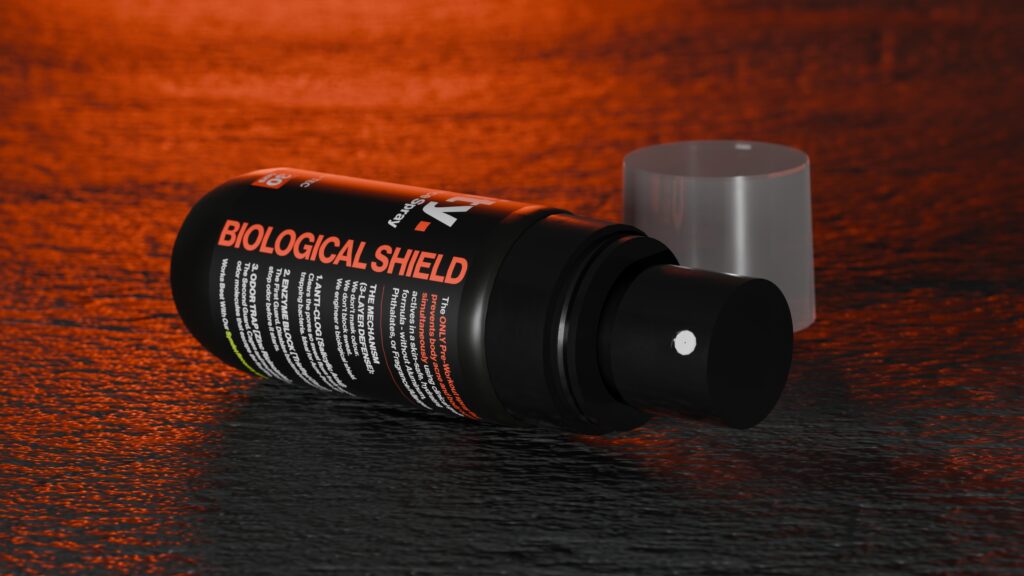
| Pre-Workout Defence Spray — Biological Shield |
| Apply 5 minutes before training. Allow to dry. |
| → Salicylic Acid (Anti-Clog): Clears pores before sweat starts flowing, preventing the occlusion that leads to acne mechanica. |
| → Triethyl Citrate (Enzyme Block): Disables bacterial esterases before training — the enzymes that convert sweat into malodorous compounds. |
| → Zinc Ricinoleate (Odour Trap): Cages odour molecules that escape the first line of defence. |
| → Niacinamide: Anti-inflammatory support during the high-stress thermal environment of training. |
| → 0% Aluminum, 0% Fragrance, 0% Allergens — non-occlusive, non-drying, respirable-safe. |
| pH 4.5 — Formulated at the lower end of the healthy acid mantle range to pre-acidify the skin before the alkaline shift begins. |
| Syndet Recovery Wash — Biological Reset |
| Apply post-workout. Massage into high-sweat zones. Rinse. Reset. |
| → Capryloyl Glycine (pH Inhibition): Creates a pH-hostile environment inhibiting C. acnes growth without harsh biocides. |
| → Zinc PCA (Sebum Control): Acts as a 5-alpha reductase inhibitor to regulate excess oil production mobilised during training. |
| → Triethyl Citrate (Enzyme Block): Disables bacterial esterases responsible for converting residual sweat into malodorous compounds. |
| → Syndet (Synthetic Detergent) base — not soap. No saponified fats that disrupt the acid mantle. Maintains pH 5.5 during cleansing. |
| → 0% Sulfates (SLES/SLS), 0% Parabens, 0% Phthalates — designed for repeated athletic use. |
| pH 5.5 — Precisely within the healthy acid mantle range to support immediate barrier recovery post-workout. |
The Bottom Line
The skin during a workout is not the same organ it is at rest. It is vasodilated, hyper-absorptive, lipid-depleted, and microbiologically stressed. Treating it with a static, timing-agnostic routine is the reason body acne and odour persist despite having a skincare regimen.
The protocol is not complicated. Strip occlusives before you train. Apply nothing active before you train. Cleanse immediately, with lukewarm water, the moment you stop. Replenish the barrier before your skin can dehydrate. Reserve your potent actives for deep rest.
The Projekt Clarity Pre-Workout Defence Spray and Syndet Recovery Wash were built specifically for these two intervention windows — formulated at the pH values your skin needs, with the actives that address the actual physiology of athletic training, not the aesthetics of a bathroom shelf.
Performance care is not about smelling good. It’s about keeping the skin barrier intact so you can keep training.
References
- Effect of Exercise-induced Sweating on facial sebum, stratum corneum hydration, and skin surface pH in normal population. PubMed. Accessed April 5, 2026. https://pubmed.ncbi.nlm.nih.gov/22891649/
- Effects of Exercise on the Skin Epithelial Barrier of Young Elite Athletes — Swimming Comparatively to Non-Water Sports Training Session. ResearchGate, 2021. https://www.researchgate.net/publication/348448099
- Park et al. Influence of cosmetic foundation cream on skin condition during treadmill exercise. Journal of Cosmetic Dermatology, 2024. DOI: 10.1111/jocd.16205. PubMed: https://pubmed.ncbi.nlm.nih.gov/38444348/
- Effect of exercise and heat exposure on percutaneous absorption of methyl salicylate. PubMed. https://pubmed.ncbi.nlm.nih.gov/3780827/
- Assessment of in vitro percutaneous absorption of glycolic acid through human skin sections using a flow-through diffusion cell system. PubMed. https://pubmed.ncbi.nlm.nih.gov/9865450/
- Training, Cleansing, and the Cutaneous Microbiome: Implications for Athlete Skin Health, Infection Risk and Performance. Premier Science. https://premierscience.com/pjsps-25-1025/
- Truncal Acne: Pathophysiology, Clinical Features, and Management Strategies. PMC. https://pmc.ncbi.nlm.nih.gov/articles/PMC12905031/
- The Effects of Physical Activity on Skin Health: A Narrative Review. PMC. https://pmc.ncbi.nlm.nih.gov/articles/PMC12417714/
- Transepidermal Water Loss Study. Active Concepts LLC. https://activeconceptsllc.com/wp-content/uploads/2022/10/16503PF-ACMoisturePlexAdvancedPF-TEWLStudy-v2.pdf
- From Skincare to Skin Fitness: A Performance Framework for Dermatologic Practice. JCAD. https://jcadonline.com/from-skincare-to-skin-fitness-a-performance-framework-for-dermatologic-practice/