
Key Insights
| • Traditional bar soaps have an average pH of 10.3 nearly 100,000x more alkaline than healthy skin (pH 4.5–5.5). |
| • This single fact triggers three damage pathways: enzyme dysregulation, lipid extraction, and protein denaturation. |
| • Syndet surfactants like Sodium Cocoyl Isethionate (SCI) form micelles of ~33.5 Å radius — physically too large to penetrate the skin’s pores (~29 Å), so they clean the surface without entering the barrier. |
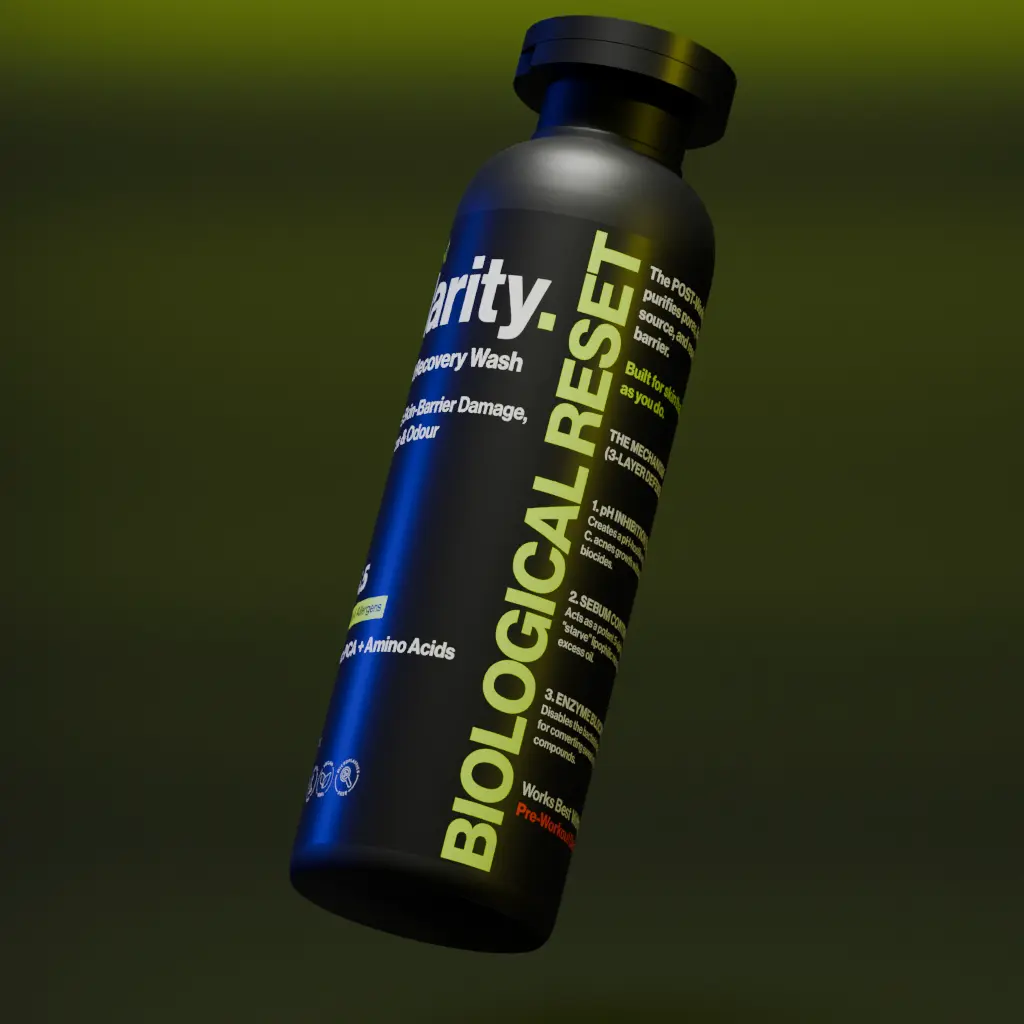
| • Projekt Clarity’s Biological Reset Syndet Recovery Wash (pH 5.5) uses a Coco-Glucoside and Cocamidopropyl Betaine syndet system no soap, no saponified fats — designed specifically for post-workout skin recovery. |
| • The Pre-Workout Defence Spray (pH 4.5) operates at the lower end of the skin’s physiological range, actively priming the acid mantle before training begins. |
The Problem With Bar Soap Nobody Talks About
Walk into any Indian gym locker room. The bar soap is there. It has always been there. It does the job — or so it looks. But here is what is actually happening every time you lather up with a traditional soap after a heavy session: you are stripping the biological infrastructure your skin depends on to stay healthy.
This is not conjecture. It is documented across multiple controlled clinical trials, in vitro protein models, and biochemical assays. The evidence is exhaustive. The shift from soap to syndet technology is not a skincare trend — it is a clinical correction.
What Is the Acid Mantle, and Why Does It Matter to Athletes?
Healthy skin maintains a surface pH of 4.5 to 5.5. This is the acid mantle and it is not just a cosmetic feature. It is a functional biological requirement.
The acid mantle does three critical things:
- It regulates the enzymes (beta-glucocerebrosidases) that produce ceramides the ‘mortar’ between your skin cells.
- It keeps kallikrein proteases in check, preventing premature breakdown of the corneodesmosomes that hold the stratum corneum together.
- It maintains an environment that favours beneficial bacteria like Staphylococcus epidermidis while suppressing Cutibacterium acnes and Staphylococcus aureus.
For athletes, this matters more than for anyone else. Post-workout skin is a different physiological environment: elevated temperature, occluded pores, sweat residue, increased transepidermal water loss (TEWL). The barrier is already under mechanical stress. What you wash with post-session is not a minor detail — it is the critical intervention point.
Three Ways Traditional Soap Damages Your Skin Barrier
1. pH Spike and Enzyme Shutdown
Traditional soap has an average pH of 10.3, with some antibacterial bars hitting 11.1. This is a non-negotiable chemical property — you cannot make soap pH-neutral without it reverting to insoluble fatty acid form. It ceases to function as soap.
When soap elevates skin pH to 10–11, the immediate biochemical consequences are:
- Beta-glucocerebrosidase activity is inhibited, blocking ceramide synthesis.
- Kallikrein protease activity spikes, accelerating premature desquamation.
- The microbiome shifts toward opportunistic pathogens within hours.
A 10-week double-blind study confirmed that subjects using alkaline soap showed persistent elevated skin pH — the acid mantle does not recover quickly. The barrier stays vulnerable for hours after each wash.
pH and Microbiome Impact by Cleanser Type
| Product Type | Mean pH | pH Range | Microbiome Impact |
| Traditional Bar Soap | 10.3 | 8.01–12.38 | Significant disruption; favours pathogens |
| Antibacterial Bar Soap | 11.1 | 10.0–11.34 | Severe disruption; pH shock |
| Syndet Bar | 6.0 | 4.99–7.78 | Minimal disruption; supports commensals |
| Liquid Syndet | 5.9 | 4.54–8.08 | Variable; generally skin-friendly |
Source: Cross-sectional study of handwash products, Riyadh, Saudi Arabia (PMC10931849); study of 250 commercial products.
2. Lipid Extraction — Pulling the Mortar Out of the Wall
Soap molecules intercalate into the lipid bilayers of the stratum corneum. They form mixed micelles with your skin’s native ceramides, cholesterol, and free fatty acids. When you rinse, those micelles wash away — and so does the structural lipid mortar.
Transmission electron microscopy (TEM) has visually confirmed this: skin washed with alkaline soap shows visible lipid depletion and disrupted lamellar architecture. The result is a measurable, sustained increase in TEWL — water escaping through a broken seal. A healthy forearm reads 5–10 g/m²/h. After alkaline soap exposure, TEWL can exceed 15 g/m²/h, a threshold defined as barrier dysfunction, and may not return to baseline even 72 hours after a single exposure.
3. Protein Denaturation — The Swelling-Shrinking Cycle
Harsh anionic surfactants bind to keratin fibers and denature them. During washing, the denatured proteins absorb excess water and swell. After rinsing, as the water evaporates, the structurally compromised keratin shrinks rapidly — creating mechanical stress on the skin surface. This is the ‘after-wash tightness’ you feel. It is not a sign of cleanliness. It is a symptom of protein damage and Natural Moisturizing Factor (NMF) loss.
In Vitro Irritancy: Zein Solubility Scores by Surfactant
| Cleansing Agent | Zein Score (mg/g) | Irritancy Potential |
| Sodium Lauryl Sulfate (SLS) | >400 | Extremely High |
| Traditional Soap (Carboxylate) | 300–450 | High |
| Sodium Laureth Sulfate (SLES) | 200–300 | Moderate |
| Cocamidopropyl Betaine (CAPB) | <100 | Low |
| Sodium Cocoyl Isethionate (SCI) | <50 | Very Low / Mild |
Source: Zein Solubility Test data from Colonial Chemical / Society of Cosmetic Chemists; CIR Safety Assessment of Isethionate Salts.
Why Syndet Technology Solves This
The Physics of Micelle Size
The most important concept in understanding syndet mildness is micelle size. Surfactant monomers are small enough to penetrate the aqueous pores of the stratum corneum (~29 Å radius) and trigger inflammation in deeper epidermal layers.
Sodium Cocoyl Isethionate (SCI), the gold-standard mild syndet surfactant, forms micelles with an average radius of approximately 33.5 Å — physically larger than the skin’s pores. This is size exclusion: the micelles clean the surface but cannot enter the barrier. The clinical irritancy of SCI is a fraction of 1/8th that of traditional soap.
Micelle Radius vs. SC Pore Radius: Penetration Potential
| Surfactant | Micelle Radius (Å) | SC Pore (~29 Å) | Clinical Irritancy |
| Soap (Sodium Laurate) | ~15–20 | Penetrates | High |
| Sodium Lauryl Sulfate | ~18–22 | Penetrates | Very High |
| Sodium Cocoyl Isethionate | ~33.5 | Excluded | Very Low |
| SCI + Fatty Acid Blend | >35 | Excluded | Negligible |
Source: CIR Amended Safety Assessment of Isethionate Salts (cir-safety.org); PMC8954092.
Syndet Surfactant Synergy
Effective syndet formulations do not rely on a single surfactant. They blend surfactant classes:
- Mild Anionic (e.g., SCI, Sodium Cocoyl Glutamate): Primary cleansing action with low irritancy.
- Amphoteric (e.g., Cocamidopropyl Betaine): Carries both charges, stabilises the surfactant system, reduces monomer concentration.
- Non-ionic (e.g., Coco-Glucoside, Alkyl Polyglucosides): Extremely mild, contributes lather without disrupting barrier lipids.
By keeping surfactants in a blended micellar system, formulators reduce the proportion of monomers — the most damaging form of surfactant. Fewer monomers means less penetration, less irritation, faster TEWL recovery.
TEWL Recovery: The Clinical Evidence
In comparative clinical trials, the gap in TEWL outcomes between soap and syndet is stark. Alkaline soap causes a sustained TEWL increase that often does not return to baseline even 72 hours after a single patch-test exposure. SCI-based syndets show a minimal, transient TEWL increase that typically normalises within one week of regular use. In a 4-week study of sensitive-skin individuals, the SCI-syndet group showed improved stratum corneum hydration at week 4; the soap group did not improve.
Where Projekt Clarity Fits Into This Science
Projekt Clarity was built on one premise: personal care for athletes is a performance problem, not a vanity problem. The research above is not the backdrop to what we do — it is the specification from which our products were engineered.
Biological Reset — Syndet Recovery Wash (pH 5.5)
The Biological Reset is a post-workout syndet wash formulated at pH 5.5 — directly within the skin’s physiological acid mantle range. The surfactant system uses Coco-Glucoside and Cocamidopropyl Betaine — no soap, no saponified fats, no SLES or SLS. Saponified fats are explicitly excluded by design.
Its 3-Layer Defence mechanism addresses the specific post-workout skin environment:
- pH Inhibition via Capryloyl Glycine: Creates a pH-hostile environment that inhibits Cutibacterium acnes growth without harsh biocides.
- Sebum Control via Zinc PCA: Acts as a 5-alpha reductase inhibitor, regulating excess oil that feeds lipophilic microbes after exercise.
- Enzyme Block via Triethyl Citrate: Disables bacterial esterases responsible for converting sweat into malodorous volatile compounds.
Supporting ingredients include Sodium Cocoyl Glutamate (mild amino-acid surfactant), Glycerin (humectant), and Xanthan Gum. Zero sulphates, zero synthetic fragrance, zero parabens.
Biological Shield — Pre-Workout Defence Spray (pH 4.5)
The Biological Shield operates at the lower physiological limit: pH 4.5. Applied 5 minutes before training, it pre-primes the acid mantle before the stress of exercise begins.
Its mechanism:
- Anti-Clog via Salicylic Acid (BHA): Clears pore channels so sweat flows freely without trapping bacteria — critical for acne-prone skin.
- Enzyme Block via Triethyl Citrate: First-line guard against odour-generating bacterial enzymes.
- Odour Trap via Zinc Ricinoleate: Physically cages and neutralises odour molecules that escape enzymatic inhibition.
Niacinamide provides anti-inflammatory support to the follicular microenvironment. No aluminium salts, no synthetic fragrance, no aerosol propellants, no ethanol.
Used together as a system — spray before, wash after — these two products bracket the training session, maintaining the acid mantle integrity at both ends.
Head-to-Head: Traditional Soap vs. Syndet vs. Projekt Clarity
| Parameter | Traditional Soap | Generic Syndet | Projekt Clarity System |
| pH | 9.0–11.0 | 5.0–7.0 | 4.5–5.5 (exact) |
| Acid Mantle Impact | Disrupts for hours | Maintains | Maintains + pre-primes |
| Surfactant | Saponified fatty acids | Varies | SCI-class, amino-acid, APG |
| Acne Actives | None | Rarely | Salicylic acid + Capryloyl Glycine |
| Odour Control | None | None | Triethyl Citrate + Zinc Ricinoleate |
| Sebum Regulation | None | None | Zinc PCA (5-AR inhibitor) |
| Allergen / Fragrance | Often present | Variable | 0% fragrance and allergens |
| Hard water residue | Forms soap scum | None | None |
The Bottom Line
If you are training seriously, your post-workout wash is not a personal care product. It is a recovery intervention. Traditional soap, regardless of how familiar it feels, is clinically documented to damage the skin barrier through pH-driven enzyme shutdown, lipid extraction, and protein denaturation. These are not theoretical risks — they are measured with transepidermal water loss sensors, electron microscopes, and protein solubility assays.
Syndet technology, particularly systems built around large-micelle mild surfactants operating at physiological pH, solves this problem at a biochemical level. Projekt Clarity’s Biological Reset and Biological Shield take this further by adding performance actives — odour inhibitors, sebum regulators, and pore-clearing BHA — tuned specifically for the demands of training. This is not skincare. It is performance maintenance.
References
- Fluhr JW, Darlenski R, Surber C. Skin Cleansing Without or With Compromise: Soaps and Syndets. Skin Pharmacol Physiol. 2021. PMC8954092.
- Ananthapadmanabhan KP et al. A Novel Technology in Mild and Moisturizing Cleansing Liquids. Cosmetic Dermatology. 2004. Available via MDedge.
- Tarun J et al. A Comparative Study of Soap and Syndet Bars: Formulation, Benefits and Efficacy in Skin Care. ResearchGate. 2024.
- Draelos ZD. Soaps, Syndets, and Detergents. Clinikally.com; Typology UK library, 2024.
- Lm Skincentre. Comparing the Effects of Soap-Based Versus Syndet Cleansing Bars on Skin Health. lmskincentre.com, 2023.
- Al-Ghamdi KM et al. Exploring pH Levels and Environmental Impacts on Handwash Products in Riyadh, Saudi Arabia. PMC. 2024. PMC10931849.
- Fluhr JW, Elias PM. Stratum Corneum pH: Formation and Function of the ‘Acid Mantle’. Exog Dermatol. 2002.
- Cosmetic Ingredient Review (CIR). Amended Safety Assessment of Isethionate Salts as Used in Cosmetics. cir-safety.org. 2013.
- Barel AO, Paye M, Maibach HI. Handbook of Cosmetic Science and Technology. 3rd ed. 2009.
- Ananthapadmanabhan KP et al. Differentiating Soaps and Syndets: Effects on Skin Barrier. Soap Chamber Test study. ResearchGate. PMC3425021.
- Colonial Chemical / Society of Cosmetic Chemists. A Comprehensive View of Surfactant Irritation Potential — Zein Scores. colonialchem.com. 2024.
- Draelos ZD. Benefits of Mild Cleansing: Synthetic Surfactant-Based (Syndet) Bars. Cosmetic Dermatology. 2005. MDedge.