
KEY INSIGHTS
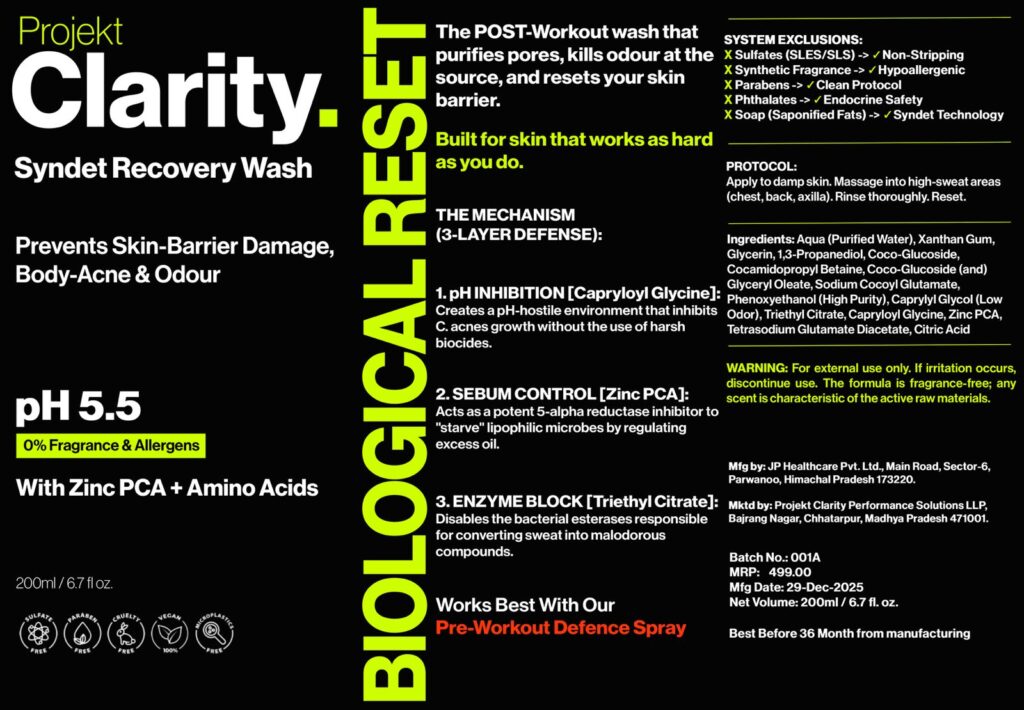
| Sodium benzoate and potassium sorbate are only antimicrobially active in their undissociated (acid) form — pH is everything. In a body wash, surfactant micelles physically trap the preservative, pulling it out of the water phase where bacteria actually live. In a body spray, rapid ethanol evaporation hyper-concentrates the same preservatives on your skin — raising skin-irritation risk, not preservative efficacy. EU regulations cap sodium benzoate at 2.5% in rinse-off but only 0.5% in leave-on products — a 5× difference driven entirely by this physics. Clarity’s Pre-Workout Body Spray (PWO-BS-001) uses a pH 4.0–4.5 formulation with sodium benzoate at 0.20% and potassium sorbate at 0.20% — both well within the safe leave-on limit while exploiting synergy to achieve broad-spectrum protection. Clarity’s Advanced Body Wash (BW-SH-004B) uses Phenoxyethanol + Caprylyl Glycol rather than organic acids — deliberately bypassing the micellar sequestration problem that organic acids face in surfactant-heavy matrices. |
The Preservative Paradox: Same Molecule, Different Behaviour
If you pick up two products from a pharmacy shelf — a body wash and a body spray — and both list sodium benzoate and potassium sorbate in the INCI, you would be forgiven for assuming they work the same way. They do not. The physics of what happens to these two molecules after they leave the manufacturing vessel and enter each product format are so radically different that global regulators impose a 5× difference in the maximum permitted dose depending on whether you are rinsing the product off or leaving it on.
Understanding this is not academic chemistry. For an athlete applying a performance body spray before training, it determines whether the preservative system is actually protecting the product — or whether it is being concentrated on their skin at levels that cause contact reactions. Clarity was built to engineer around exactly these kinds of gaps.
The Mechanism: Organic Acids Only Work When Undissociated
Sodium benzoate and potassium sorbate are used as their salt forms during manufacturing purely for solubility. But the salts themselves are biologically inert. The antimicrobial action depends on the undissociated free acid form — benzoic acid (pKa 4.18–4.20) and sorbic acid (pKa 4.75–4.76) — which is lipophilic and can passively diffuse across microbial cell membranes.
Once inside the microbial cytoplasm, the acid dissociates (because intracellular pH sits at 6.5–7.0), floods the cell with protons, forces the bacterium to activate ATP-consuming proton pumps to restore homeostasis, depletes energy reserves, and eventually kills the cell. The critical implication: as formulation pH rises above the pKa, the proportion of active undissociated acid drops exponentially. The Henderson-Hasselbalch equation makes this precise.
Table 1: pH vs. Active Undissociated Fraction (Henderson-Hasselbalch)
| Formulation pH | Benzoic Acid % Active | Sorbic Acid % Active | Preservative Viability |
| 3.5 | 83.4% | 94.8% | High — skin barely tolerates this |
| 4.0 | 61.3% | 85.2% | Optimal target — efficacy + skin compatibility |
| 4.5 | 33.4% | 64.5% | Declining rapidly |
| 5.0 | 13.7% | 36.5% | Borderline — boosters required |
| 5.5 | 4.8% | 15.4% | Severe failure risk |
| 6.0 | 1.5% | 5.5% | Effectively unprotected |
Source: Henderson-Hasselbalch derivations from thermodynamic pKa values. [Ref 1, 2]
This table is not theoretical — it is the operating reality of every formulator who uses these preservatives. A body wash that drifts from pH 5.0 to 5.5 during storage has just lost two-thirds of its effective benzoic acid concentration.
The Body Wash Problem: Micelles Are Eating Your Preservative
A rinse-off body wash is a surfactant-dominated system. Modern mild cleansers like Clarity’s BW-SH-004B use Coco-Glucoside, Cocamidopropyl Betaine, and Sodium Cocoyl Glutamate at combined active surfactant matter (ASM) around 8.84%. Above the Critical Micelle Concentration, surfactant molecules self-assemble into micelles — spherical structures with a hydrophilic exterior and a lipophilic interior core.
Here is the fundamental problem: the same lipophilic character that allows undissociated benzoic acid and sorbic acid to penetrate microbial membranes also makes them thermodynamically attracted to the hydrophobic interior of micelles. Advanced COSMOmic computational modelling has confirmed that undissociated organic acids partition readily into alkyl sulfate and alkyl glucoside micelles. The result is the ‘formulation paradox’: the properties that make these molecules effective antimicrobials are the same properties that get them sequestered inside micelles, pulling them out of the aqueous phase where bacteria actually live.
Formulators have to overdose the preservative in body washes to compensate — which is why EU SCCS permits sodium benzoate up to 2.5% (as acid) in rinse-off formats. The generous ceiling is not because the product is inherently safer; it is because so much of the dose is being lost to micellar sequestration. [Ref 3]
What Happens During Rinsing
When the consumer dilutes the lather with shower water, surfactant concentration drops below the CMC, micelles collapse, and the sequestered preservative is released. But simultaneously, the massive water volume dilutes the total preservative concentration to well below its Minimum Inhibitory Concentration (MIC). Residential tap water also buffers toward neutral pH, inactivating whatever active acid remains by pushing it above its pKa.
Net effect: the preservative system in a body wash is operationally inactive during the actual rinse. Its only job is ‘in-can’ preservation — keeping the sealed product microbiologically stable on the shelf and in the bathroom over its shelf life. It confers no meaningful antimicrobial benefit (or toxicological risk) to the user’s skin.
Why Clarity’s Body Wash Does Not Use Organic Acids
Clarity’s Advanced Purifying Body Wash (BW-SH-004B) deliberately avoids sodium benzoate and potassium sorbate as primary preservatives. The formulation uses Phenoxyethanol (0.60%) and Caprylyl Glycol (0.40%) — a system that is not micellar-partition-limited and is not pH-dependent in the same way. The result passes all mandatory validation protocols (PET, HRIPT, accelerated stability, freeze-thaw) without forcing a micellar overdose problem or a pH management tightrope.
The Body Spray Problem: Ethanol Evaporation Concentrates Everything
A leave-on hydroalcoholic body spray is a fundamentally different environment. There are no significant surfactant micelles. Sodium benzoate and potassium sorbate are fully dissolved in the bulk aqueous-alcoholic phase — unhindered and immediately available. This looks like an advantage. It is, until the spray hits skin.
Ethanol evaporates from skin with a half-life of approximately 11.7 seconds on intact skin. As the solvent fraction (80–90% of total mass) flash-evaporates in the first minute after application, the non-volatile components — including the preservative salts — are left behind on the stratum corneum. What started as, say, a 0.2% preservative concentration in the bottle becomes a hyper-concentrated residue on the skin surface. The ‘concentration factor’ drives local exposure far above the formulary dose. [Ref 5]
Ethanol Also Breaks Your Skin Barrier
The hazard compounds because ethanol is not just a carrier — it is a known skin penetration enhancer. By extracting free fatty acids and ceramides from the stratum corneum, ethanol fluidises the lipid bilayer and opens a window for transdermal absorption of co-applied ingredients. In vitro percutaneous absorption studies show that benzoic acid can cross into the receptor phase at a median of 45% of the applied dose under conditions representative of leave-on, ethanol-facilitated exposure, with peak flux rates up to 3.0% per hour. [Ref 5]
In practical terms: apply a poorly formulated body spray pre-workout, and you may not just have a preservation problem — you may have an active irritation problem. Sodium benzoate is a primary causative agent of Non-Immunologic Immediate Contact Reactions (NIICR): localised erythema and oedema that appear without prior sensitisation. Clinical patch-test cohort data shows that irritant reactions to sodium benzoate outnumber true allergic responses by more than 3:1. [Ref 3, 6]
The Regulatory Response: 5× Tighter Limits for Leave-On
Global regulators responded to exactly these physics with hard concentration caps. The EU Scientific Committee on Consumer Safety (SCCS) permits sodium benzoate at up to 2.5% (as acid) in rinse-off products, and only 0.5% (as acid) in leave-on formats. That 5× differential is not cautious bureaucracy — it is a direct translation of the evaporation and penetration science above. [Ref 6]
Table 3: Regulatory Limits — Sodium Benzoate & Potassium Sorbate
| Preservative | EU SCCS Rinse-Off Max | EU SCCS Leave-On Max | US CIR Assessment |
| Sodium Benzoate | 2.5% (as acid) | 0.5% (as acid) | <1.0% leave-on (modern practice) |
| Potassium Sorbate | No separate limit; <1.0% typical | No separate limit; <1.0% typical | 1.0% all formats |
Source: SCCS Opinion on Benzoic Acid and Sodium Benzoate; CIR Final Report on Potassium Sorbate. [Ref 6, 7]
How Clarity Engineered PWO-BS-001 Around These Constraints
Clarity’s Pre-Workout Body Spray (PWO-BS-001) is an aqueous, surfactant-free leave-on formulation. Given the complete absence of a micellar phase, preservative bioavailability is high. Given leave-on application, the 0.5% sodium benzoate ceiling applies. The formulation addresses this with three deliberate decisions:
- pH hard-locked at 4.0–4.5: At pH 4.0, benzoic acid is 61.3% undissociated and sorbic acid is 85.2% undissociated — both near peak antimicrobial activity. This is the primary efficacy lever.
- Synergistic dual-preservative system: Sodium benzoate (0.20%) provides the antibacterial backbone; potassium sorbate (0.20%) closes the antifungal gap. Their synergy, quantified via Fractional Inhibitory Concentration (FIC) methodology, means the combined effect is greater than additive — effective broad-spectrum coverage within the regulatory ceiling. [Ref 2]
- Low total load: Both are well below the 0.5% (sodium benzoate) and 1.0% (potassium sorbate) leave-on ceilings, minimising NIICR risk on ethanol-exposed skin while achieving verified microbiological protection.
Table 4: PWO-BS-001 Formulation & Preservative Specifications
| Parameter | Specification |
| pH | 4.0 – 4.5 |
| Sodium Benzoate | 0.20% — well within 0.5% leave-on ceiling |
| Potassium Sorbate | 0.20% — well within 1.0% ceiling |
| Preservation strategy | pH-dependent activity + FIC synergy between both agents |
| Appearance | Clear to hazy, colourless liquid |
| Viscosity | < 100 cP (spray-optimised) |
The Athlete Context: Why This Science Actually Matters
None of this is abstract for a gym-going population. A pre-workout body spray is applied directly after a warm shower or before a session — on skin that may already be mildly compromised by heat, sweating, or abrasion. The ethanol evaporation window is short but real: the preservative concentration at the skin surface spikes immediately after application. A product poorly formulated with organic acids at borderline-high leave-on concentrations, or at a pH too high for them to work, either irritates skin or fails microbiologically — in both cases during the exact period the athlete needs maximum skin integrity.
Clarity’s position is that performance care means getting this right, not just meeting minimum regulatory compliance. The PWO-BS-001 design targets pH 4.0–4.5 rather than the upper-end 4.5–5.0 that some brands use, specifically to maximise the antimicrobial fraction of the preservative system at low total dose. The BW-SH-004B body wash avoids organic acids in a surfactant matrix entirely, replacing them with a system that does not fight micelle physics every day of the product’s shelf life.
This is performance engineering applied to personal care formulation. Not spa chemistry.
Summary
Sodium benzoate and potassium sorbate are not interchangeable across formats. In a rinse-off body wash: they are partially sequestered inside surfactant micelles, the product is diluted and pH-neutralised during use, their role is purely shelf preservation, and regulatory limits are generous (2.5%) to compensate for sequestration losses. In a leave-on body spray: they are fully bioavailable, rapid ethanol evaporation hyper-concentrates them on skin, they penetrate a barrier already disrupted by ethanol, and regulatory limits are tightly capped at 0.5% to protect against NIICR.
Formulating correctly means starting with the physics of the matrix — not defaulting to the same preservative system across every format. That is the difference between a cosmetic that is compliant on paper and one that actually performs on skin.
References
- Henderson-Hasselbalch dissociation data for benzoic acid (pKa 4.18–4.20) and sorbic acid (pKa 4.75–4.76). Sourced from: Preservative Systems in Rinse-Off vs. Leave-On Products — Clarity Internal Research Document.
- Fractional Inhibitory Concentration (FIC) synergy between sodium benzoate and potassium sorbate. Sourced from: Preservative Systems in Rinse-Off vs. Leave-On Products — Clarity Internal Research Document; cross-referenced against antimicrobial synergy literature.
- Micellar sequestration thermodynamics; NIICR clinical data; EU SCCS sodium benzoate patch-test cohort data. Sourced from: Preservative Systems in Rinse-Off vs. Leave-On Products — Clarity Internal Research Document.
- Ethanol evaporation half-life (11.7 s on intact skin); concentration factor dynamics; benzoic acid dermal penetration (median 45% across 48h, peak flux 3.0%/hr). Sourced from: Preservative Systems in Rinse-Off vs. Leave-On Products — Clarity Internal Research Document.
- EU SCCS maximum limits: sodium benzoate 2.5% rinse-off / 0.5% leave-on. Source: SCCS Opinion on Benzoic Acid and Sodium Benzoate (European Commission). Referenced in: Preservative Systems in Rinse-Off vs. Leave-On Products — Clarity Internal Research Document.
- CIR potassium sorbate 1.0% safe limit across all cosmetic formats. Source: CIR Expert Panel Final Report on Safety Assessment of Sorbic Acid and Potassium Sorbate. Referenced in: Preservative Systems in Rinse-Off vs. Leave-On Products — Clarity Internal Research Document.